
You can know that someone loves you and, in the middle of an argument, feel completely convinced that they never cared. You can be capable and composed at work, then come home and feel overwhelmed and dysregulated by a simple conversation. Sometimes you might feel intensely upset, unually happy, or feel strangely absent, as though you are watching your life happen from a distance.
Afterward, you may wonder: Why did I react like that? Why couldn’t I remember all the good things about this person? Why do I understand what happened now, but feel something entirely different in the moment? It is almost like you don’t recognize yourself at times.
Experiences like these can happen to us and they can often be signs of splitting or dissociating. Splitting and dissociation are two concepts that I find myself often explaining to clients, as they tend to come up very frequently amongst clients with C-PTSD and developmental trauma. Mostly because these patterns of behavior are often at the root of relational difficulties or on-going conflict. Splitting and Dissociation describe two different experiences, though they can sometimes occur together.
Really understanding the difference can make it easier to recognize what is happening and begin working toward owning more choice in how you respond (and thus, making your relationships more smooth and less tumultuous).
What Is Splitting?
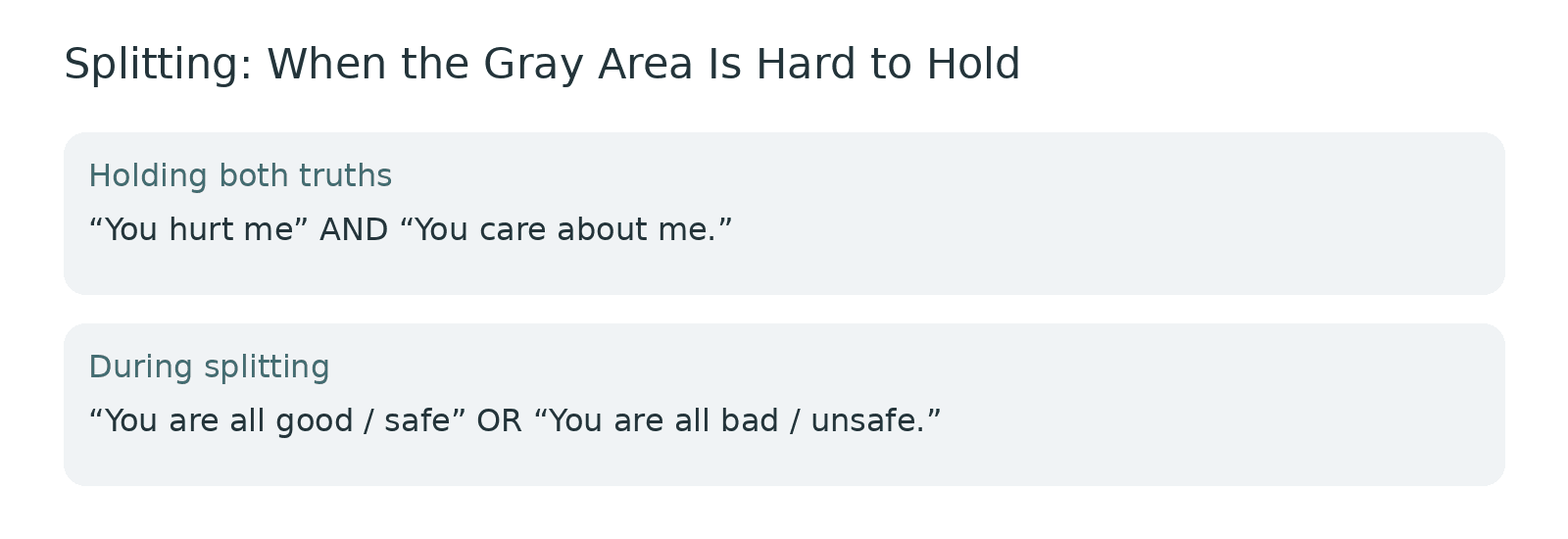
Splitting is a term used to describe the experience of having difficulty holding positive and negative feelings about yourself or another person at the same time. Your view can shift toward one extreme: someone feels entirely safe and caring, or entirely hurtful and untrustworthy.
Imagine that your partner has usually been attentive and supportive. One evening, they seem distracted and respond sharply when you ask a question. Rather than experiencing this as a painful moment within an otherwise caring relationship, you suddenly feel certain that the relationship has always been a mistake and that they must be a bad partner, or a bad person in general to you have to get away from.
The supportive moments may still be in your memory, but they feel emotionally unavailable. Remembering them doesn’t help to change the sense of rejection you are experiencing right now.
Splitting can also turn inward. One day you feel capable and worthwhile. After a mistake or criticism, you feel like a complete failure. A difficult experience becomes a verdict on your whole identity.
Black-and-white thinking can appear in many contexts. Splitting alone does not establish a diagnosis, and a strong reaction does not automatically mean someone is experiencing it. It is also important to distinguish splitting from accurately recognizing harmful behavior. Someone can have a trauma history and correctly identify that a relationship is unsafe.
Why Trauma Can Make the Gray Area Harder to Hold
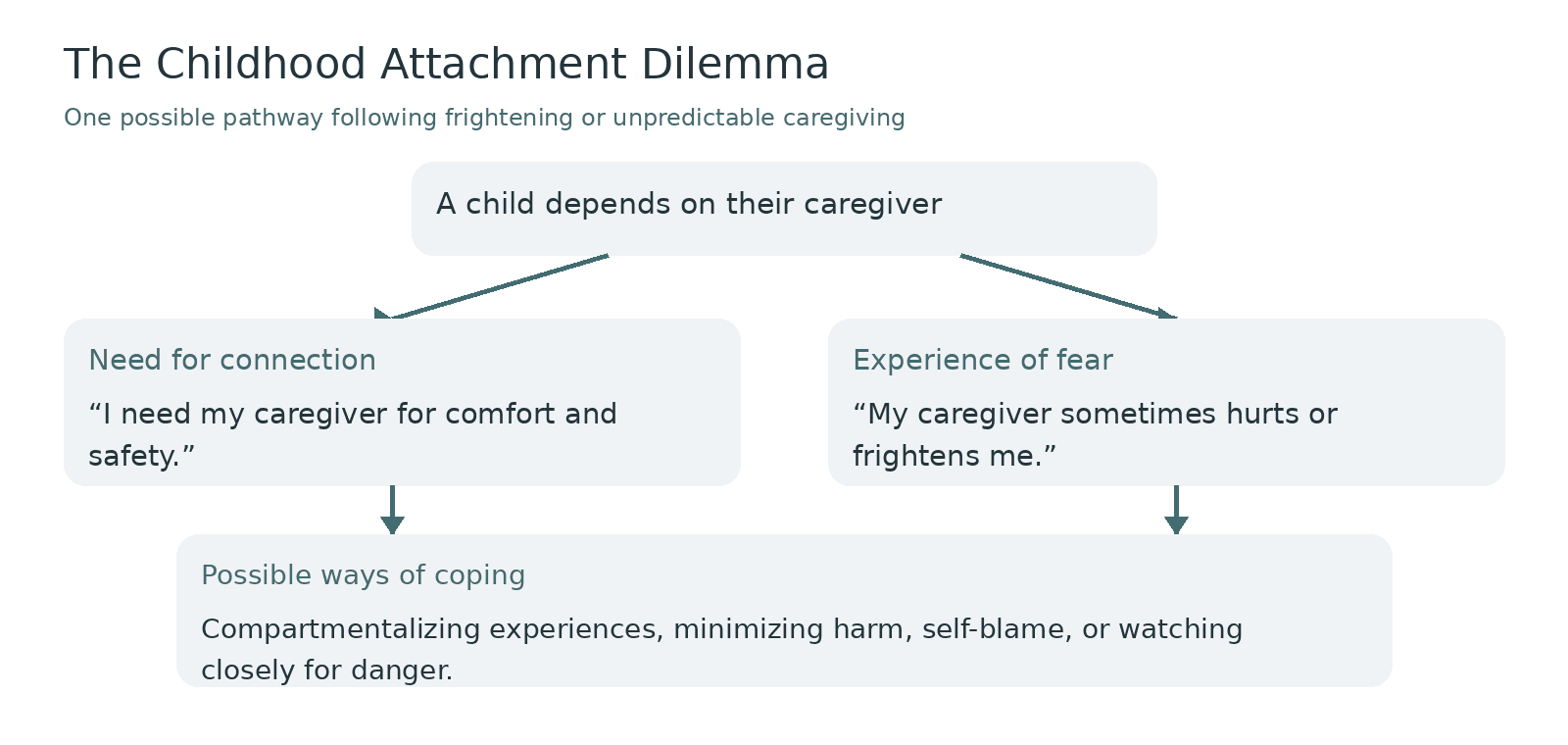
When someone grows up with unpredictable caregiving, closeness can become complicated. The person they depend on for comfort might also frighten them, criticize them, or become unavailable when they need support.
A child has limited ways to make sense of that contradiction. They may minimize the hurt, focus on the caregiver’s loving moments, blame themselves, or become exceptionally alert to changes in mood.
For some children, self-blame offers a painful sense of control: If I am the problem, maybe I can make things better by being quieter, more helpful, or perfect.
Those expectations can follow someone into adult relationships. A delayed reply might feel like abandonment. A disagreement might feel like the beginning of something dangerous. A partner’s frustration might bring up the old expectation that affection can disappear without warning, leaving you feeling abandoned and in incredible emotional pain and frantic state.
This is one possible pathway to understanding intense reactions. People’s histories differ, and there is no single childhood explanation for every instance of splitting.
Still, it can be useful to ask: What did I learn to expect when someone was upset with me? What did I have to do to stay connected or feel safe?
These questions help us understand the pattern without reducing a person to it.
What Is Dissociation, and How Is It Different?
Splitting concerns how you experience yourself or another person in extremes. Dissociation involves a disruption in the usual connection between experiences such as awareness, memory, identity, emotions, or your sense of being in your body. Everyone dissociates at times, but its degree of severity and frequency are what cue us into learning if this a more typical dissociative pattern or a pattern that needs clinical attention, such as in a mental health disorder.
Dissociation can feel like being detached from yourself, or like your surroundings are unreal. Some people describe feeling distant from what is happening even while they continue speaking or moving through their day. Others experience significant gaps in memory that go beyond ordinary forgetting.
The dissociative subtype of PTSD specifically involves depersonalization, feeling detached from yourself, and/or derealization, feeling that the world around you is unreal. Dissociation can occur alongside trauma symptoms, but it does not look the same for everyone. [1]
Picture someone who feels intensely afraid during an argument and then suddenly becomes distant and numb. Later, they have trouble describing the conversation. That experience calls for a different kind of exploration than a shift from “my partner cares” to “my partner has never cared.”
Both may be distressing. Understanding which experiences are occurring helps guide the therapeutic approach and treatment.
Understanding Structural Dissociation Without Calling Yourself “Broken”
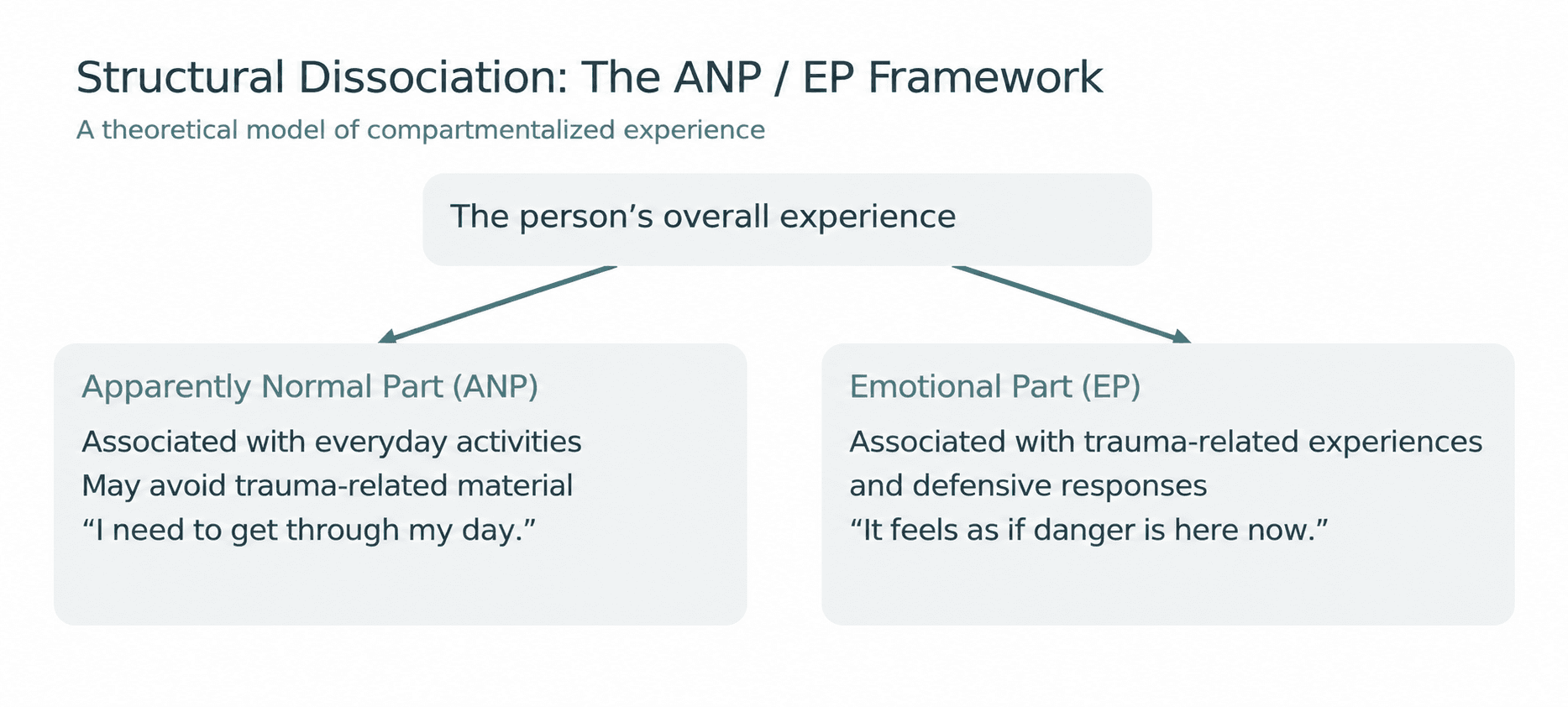
Structural dissociation theory is one framework some trauma clinicians use to understand experiences that feel compartmentalized. Developed by Onno van der Hart, Ellert Nijenhuis, and Kathy Steele, it proposes that trauma can interfere with the integration of different aspects of experience. [2]
The theory describes an “apparently normal part,” or ANP, associated with managing everyday life, and an “emotional part,” or EP, associated with trauma-related experiences and defensive responses. These are terms within a theoretical model, rather than a literal picture of separate pieces of brain tissue.
In everyday language, someone might say: Part of me knows I am safe now, but another part feels terrified. Or: I can handle my responsibilities and constructive feedback at work, but when someone raises their voice, I feel small, terrified and helpless.
The theory describes three proposed patterns: primary structural dissociation, involving one ANP and one EP; secondary structural dissociation, involving one ANP and multiple EPs; and tertiary structural dissociation, involving multiple ANPs and EPs. [2] The last one is connected to a type of dissociative disorder called “Dissociative Identify Disorder (DID) which used to be called “Multiple Personality Disorder”.
These categories can help explain the model, but they are not a checklist for diagnosing yourself. Feeling different in different situations, or using the phrase “part of me,” does not by itself mean you have a dissociative disorder.
In my practice, I avoid the phrase “fractured mind.” I often find that people who experience frequent dissociation or splitting behaviors already feel ashamed of their reactions. If a therapist was to use the word “fractured mind”, a client may hear that as confirmation that they are permanently damaged. A more useful question is: Which experiences have been difficult to connect, and what would help me feel more present, integrated and consistent in my life?. Along with some self compassion for understanding how and why these parts developed, that is, In the service of survival.
How Do C-PTSD, BPD, and DID Fit Into This?
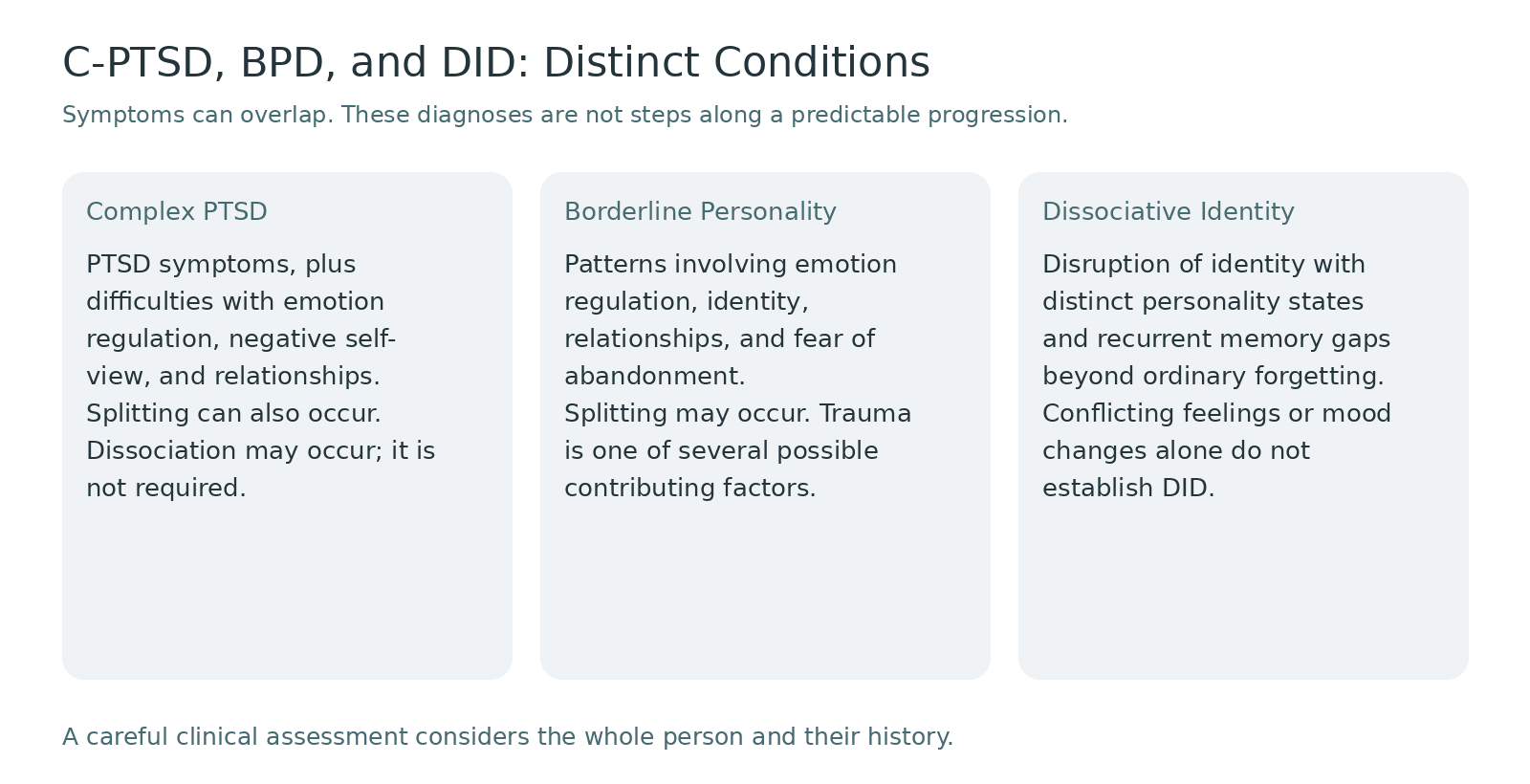
Complex PTSD, borderline personality disorder, and dissociative identity disorder can involve overlapping experiences, but they are distinct conditions. They do not form a predictable progression from less severe to more severe trauma as many people assume. But in my experience, all are connected to childhood/developmental trauma or persistent emotional neglect/invalidation by caregivers. They are just the result of different ways of coping.
Complex PTSD
Complex PTSD includes PTSD symptoms alongside persistent difficulties with regulating emotions, a deeply negative view of oneself, and persistent problems in relationships. It is often associated with prolonged or repeated trauma during childhood. Someone may struggle with shame, closeness, or feeling safe even when their circumstances have changed.
Dissociation may also be present, but it is not required for every person with complex PTSD.
Borderline Personality Disorder
BPD can involve intense emotional shifts, an unstable sense of self, an immense fear of abandonment, and relationship patterns that move between extreme closeness and extreme distress. Splitting can help describe some of these changes in perception of those people at the other end of their relationships.
Trauma is relevant for many people with BPD, but the condition has multiple contributing factors. It should not be assumed that everyone with BPD has the same history or that trauma alone explains the diagnosis. Effective psychotherapy, including dialectical behavior therapy, can help.
Dissociative Identity Disorder
DID involves disruption of identity with two or more distinct personality states, alongside recurrent memory gaps beyond ordinary forgetting. The presentation can be subtle and varies between individuals. Having conflicting feelings or shifting moods is not enough to establish DID.
Significant memory gaps or disruptions in your sense of identity warrant assessment by a clinician with appropriate expertise. A diagnosis should come from careful evaluation of your whole experience.
What Helps When Everything Suddenly Feels All Good or All Bad?
When distress is high, trying to force yourself into a balanced perspective may feel impossible. Start by noticing the shift.
You might say to yourself: I feel rejected, and my view of this person has changed very quickly. That sentence gives you a little room to observe what is happening without arguing with your feelings.
If you are physically safe, consider delaying major relationship decisions until the intensity settles. You might ask for a pause and agree on when to return to the conversation. A clear return time can help a break feel less like abandonment.
Then look for something that helps you stay present: noticing your feet on the floor, naming objects around you, or gently moving your body. Grounding should be individualized. If focusing on your breathing makes you more anxious or detached, use an external (outside of your body) point of attention instead.
Once you feel more settled, try holding two specific truths:
I am hurt by what happened, and I need more information before deciding what it means.
I made a mistake, and I can take responsibility without condemning myself.
This person has cared for me, and this behavior still needs to be addressed.
Making room for complexity does not require accepting mistreatment and it can help you respond more clearly to what actually happened.
How Therapy Can Help With Trauma, Splitting, and Dissociation
Therapy can help you recognize triggers, understand the meaning your mind assigns to them, and practice responding with more flexibility. The approach should fit your symptoms, current circumstances, preferences, and level of support.
DBT-informed skills can help with tolerating distress, regulating emotions, and communicating during conflict. CBT can help you examine conclusions that become absolute under stress. Parts-informed work may offer a compassionate way to explore competing reactions, such as wanting closeness while also feeling an urgent need to withdraw.
For PTSD, trauma-focused therapies such as EMDR and Cognitive Processing Therapy may be appropriate. When significant dissociation is present, assessment, pacing, and clinician expertise become especially important. [6]
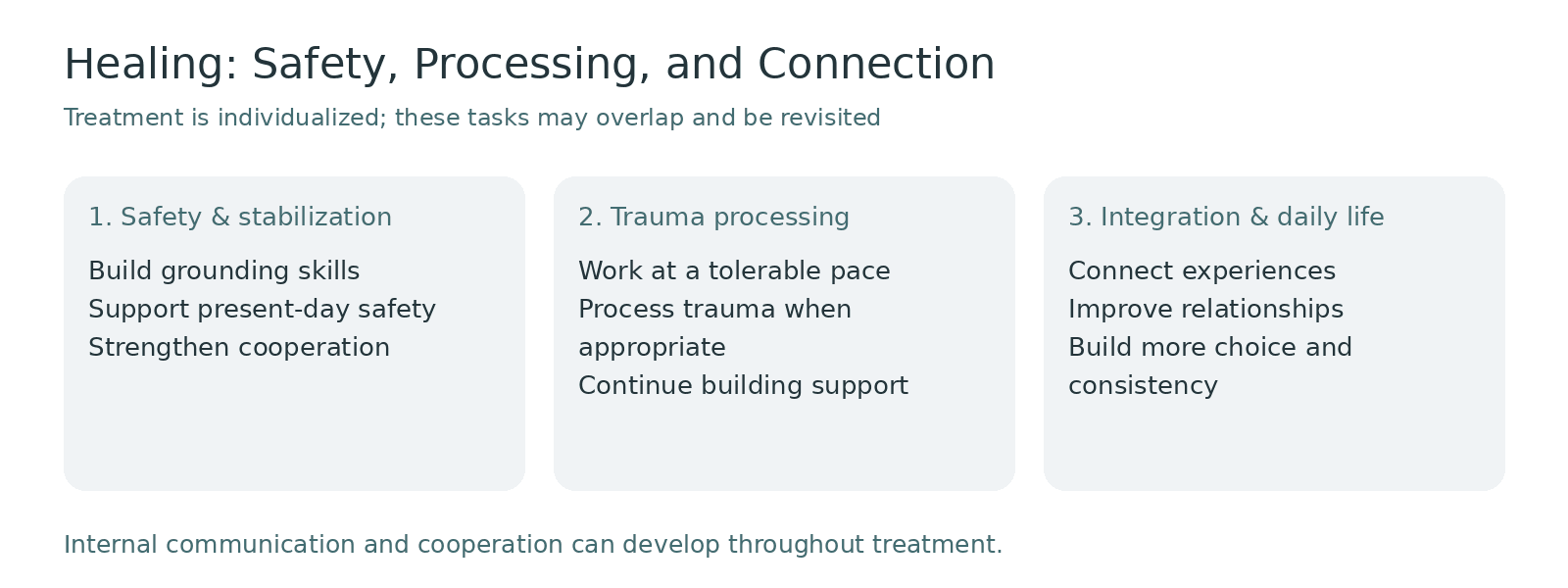
For DID, professional guidance describes treatment that typically attends to safety and stabilization, trauma processing, and integration and rehabilitation. Treatment may move between these tasks as needed. Greater cooperation and functioning are meaningful goals; care should address the individual’s needs rather than impose one predetermined outcome. [5]
Progress may look ordinary from the outside: staying present during a hard conversation, recognizing a trigger sooner, remembering that disappointment does not erase affection, or recovering from conflict with less shame.
Those changes can make daily life feel substantially different.
Trauma Therapy at North Shore Professional Therapy
At North Shore Professional Therapy, we work with people navigating anxiety, trauma, and the ways past experiences continue to affect present-day life. We offer in-person therapy in Topsfield and virtual therapy across Massachusetts.
If you recognize yourself in parts of this article, therapy can be a place to explore what those experiences mean for you. Together, we can consider an appropriate approach and whether specialized care would best support your needs.
Our work will be tailored to your nervous system, your lived experiences, and the kind of change you want to create.
You can contact North Shore Professional Therapy to discuss your concerns and explore therapist fit.
Sources and Further Reading
- U.S. Department of Veterans Affairs, National Center for PTSD. Dissociative Subtype of PTSD.
2. Van der Hart, O., Nijenhuis, E. R. S., & Steele, K. (2004). Trauma-related dissociation: Conceptual clarity lost and found. See also their 2006 book, The Haunted Self: Structural Dissociation and the Treatment of Chronic Traumatization.
3. World Health Organization. Clinical Descriptions and Diagnostic Requirements for ICD-11 Mental, Behavioural and Neurodevelopmental Disorders (2024), section on complex post-traumatic stress disorder.
4. National Institute of Mental Health. Borderline Personality Disorder.
5. International Society for the Study of Trauma and Dissociation. Guidelines for Treating Dissociative Identity Disorder in Adults, Third Revision (2011).
6. U.S. Department of Veterans Affairs, National Center for PTSD. Overview of Psychotherapy for PTSD.